


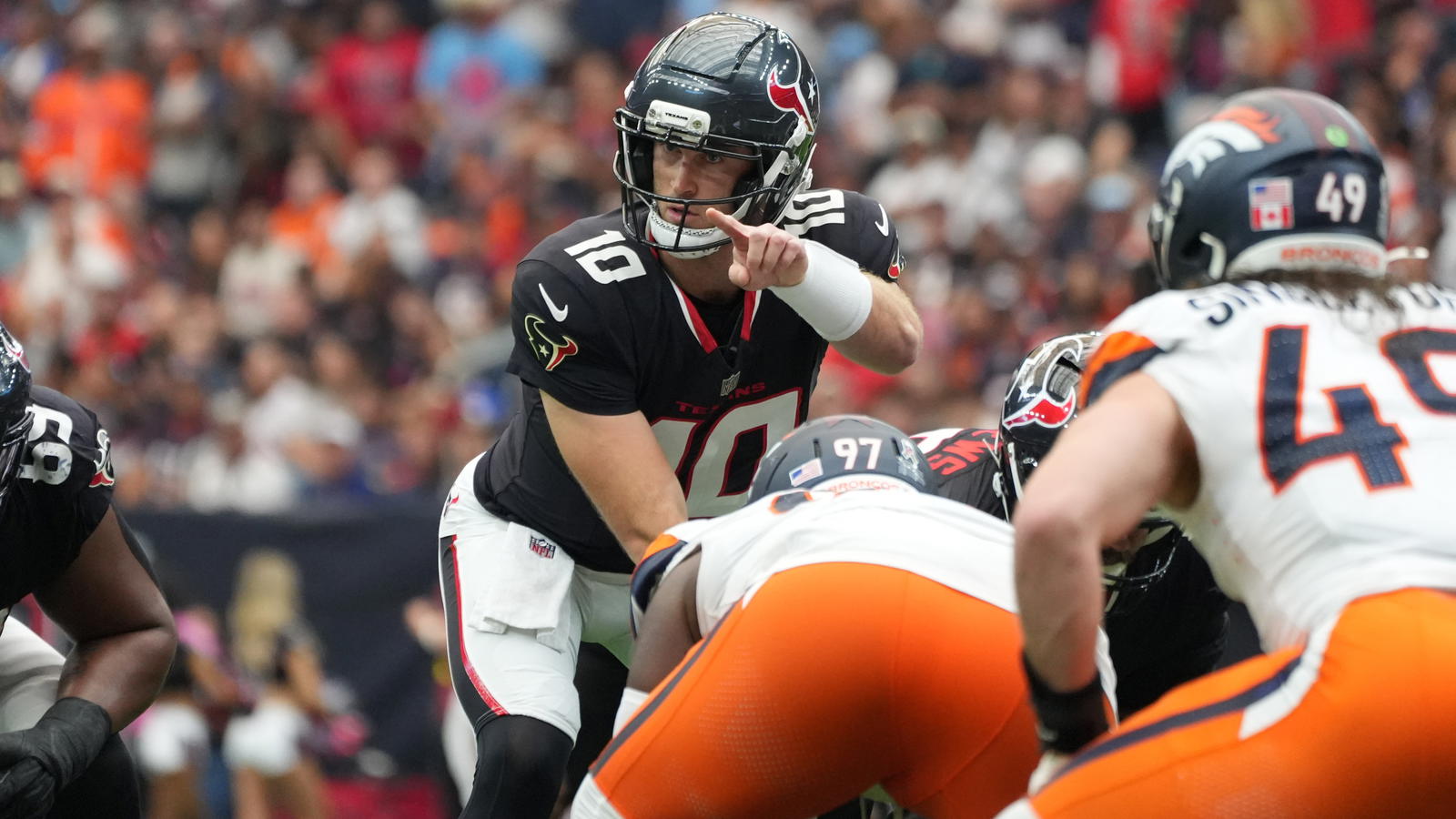
Houston's offense falters when C.J. Stroud is sidelined. Can Davis Mills and his coordinator spark a win against Jacksonville without consistent execution?
With a 3-0 Houston lead and 13:49 left in the second quarter of Sunday's contest vs. Denver, Texans quarterback C.J. Stroud was concussed inadvertently by Broncos cornerback Kris Abrams-Drain after a hit on a late slide attempt.
 Mike Cima (@Ci_World) on X
That was not an illegal hit on CJ Stroud
Somebody has to show him how to actually slide
Mike Cima (@Ci_World) on X
That was not an illegal hit on CJ Stroud
Somebody has to show him how to actually slide
He was taken out of the game for immediate testing and was ultimately ruled out for the afternoon with a concussion. Backup quarterback Davis Mills was then inserted to play the rest of the game for Stroud.
From that point on, Mills went for 17/30 (56.7%), 137 yards, two sacks, zero touchdowns and a 68.3 passer rating. The Texans went on to lose the game 18-15 after a 34-yard game-winning field goal by Broncos kicker Wil Lutz.
Head coach Demeco Ryans confirmed today with the media that Stroud is indeed in the NFL's concussion protocol, and all signs now point to backup Davis Mills being the next man up again to guide the offense for at least the next week against the Jacksonville Jaguars.
Davis Mills, Come On Down
The NFL is a next-man-up league, but Houston has serious questions to answer if Mills is truly the answer for the next game or two. Mostly, those questions start and end with offensive coordinator Nick Caley and his ability to prepare an effective game plan given his offense's propensity to produce duds in crucial moments.
At this point, Mills is who he is. Now entering his fifth season and owning a 5-19-1 record as a starter, Mills' best year was arguably his rookie season, where he threw for 2,664 yards (66.8%), 16 touchdowns, 10 interceptions, and an 88.8 passer rating. He threw for more yards (3,118) and one more touchdown (17) in year two, but he also added five more interceptions (15) and finished with 10 points worse in passer rating (78.8).
While he's not the worst alternative at quarterback, there's a reason why the Texans drafted Stroud 2nd overall in the 2023 draft. Mills is solid, but not consistent starter solid. At his best, he could possibly win you a game or two in a tight situation.
Caley's Offense Has Been Offensive
This is why most of the concern lands at the feet of the embattled Caley, who has been under fire all season from fans and media regarding his inability to engineer an offense that exceeds his predecessor in former play caller Bobby Slowik.
Houston's offense has been one of the most volatile in football. While the unit put up a 96-25 differential against the Titans, Ravens and 49ers, they also are tainted by a 86-72 difference against the Rams, Buccaneers, Jaguars, Seahawks and now Broncos. Yes, they have five losses by a combined total of 14 points.
This is due to a myriad of schematic, execution and now health-based issues (mainly schematic). Players have fumbled in red zones, offensive line combinations haven't been able to block effectively enough, hamstrings have been pulled and now two key concussions (Collins, Stroud).
With that said, the worst of it all has been Caley's perceived inability to operate in short-yardage situations and/or an unwillingness to consistently integrate rookie playmakers who have shown the ability to take over games in spurts (Higgins, Noel, Marks).
This has resulted in the Texans being the worst red zone (by touchdown) offense in the league at a 36.36% success rate (18.18% in their last three games). This paltry output has cost them at least two games (Buccaneers and Broncos) and has the team at 3-5 when an average offense possibly lifts them to 6-2.
While Mills is definitely lacking in his own right, the system that he'll possibly be operating won't do him any favors.
Will Preparation Lead to Production?
Hopefully, with a week of preparation as the starter for a day, perhaps Caley and Mills can come up with an effective enough game plan to attack a Jaguars defense that ranks 27th against the pass (249.3/game), 3rd against the run (86.9/game) and 18th in scoring (23.0/game).
If not, the Texans will be 3-6 with eight games left to play. At that point, the season may be conceded as a failure and proactive planning for offseason evaluations and changes may become the priority.