

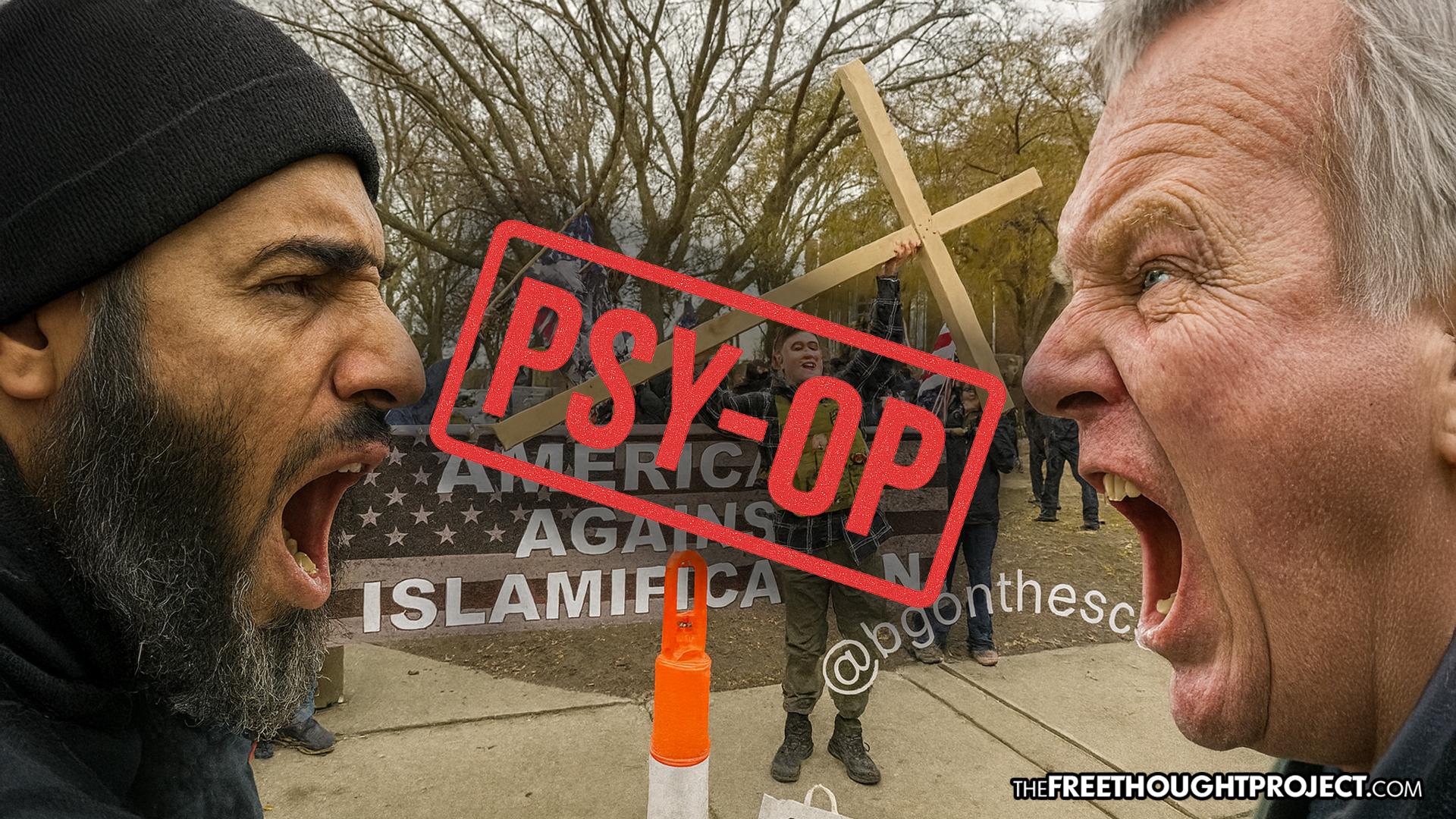


The stunt wasn’t about Muslims or Christians. It was about seeing how easily Americans can be pushed into hating each other on command.
Dearborn, MI — What unfolded in Dearborn this week wasn’t a clash of neighbors or some organic eruption of religious tension inside a city that has spent decades building a reputation for coexistence. It was a piece of political theater brought in from the outside, executed by people who don’t live there, and aimed squarely at national audiences who will never know the difference. The performance hinged on the presence of Jake Lang — a Florida Senate candidate, a Trump-pardoned January 6 defendant, and a man who has made a small career out of inserting himself into the country’s most combustible cultural fault lines.
Lang didn’t arrive quietly. He marched into Dearborn carrying a Quran he intended to desecrate, lighter fluid for dramatic effect, and strips of bacon he slapped onto the holy book in front of a wall of cameras. He held a banner that read “Americans Against Islamification,” as if the city he flew into were some foreign battleground rather than an American community where people live, work, and raise their families. Local coverage from CBS Detroit captured the scene in painful detail: Lang taunting counter-protesters, performing for cellphones, and choreographing the kind of visual confrontation that trends easily but means nothing to the people who have to live with the aftermath.
The residents of Dearborn saw through it immediately. Community leaders called it an intrusion by people who were misrepresenting their city and trying to drag them into someone else’s conflict. CAIR-Michigan described the march as a transparent attempt to divide communities that had not asked for outsiders to show up with props and slogans designed to inflame tensions. People on the ground echoed the same sentiment again and again: these weren’t local grievances, these weren’t local organizers, and these weren’t local intentions. This was imported hostility, parachuted into a city that had enough sense to recognize a setup when it saw one.
When you step back and look at Lang’s history, the picture becomes clearer. This is not a man who suddenly discovered a concern about Dearborn’s political direction. For years, he has clung to the mythology of January 6 as if it were a personal brand, framing himself as a revolutionary figure and surrounding his political identity with apocalyptic Christian nationalist rhetoric. Reporting from myriad sources documented his attempts to launch a national militia network called NAPALM — a name that tells you more about his mindset than he likely intended. He has positioned himself at the center of racially and religiously charged protests across multiple states, including a “Protect White Americans” demonstration in Texas earlier this year. He seems drawn to conflict like a moth to a flame, provided the conflict can be turned into hate-filled, divisive content.
All of that made Dearborn an irresistible stage, especially after Michigan GOP gubernatorial candidate Anthony Hudson marched through the city claiming to promote “unity” while still carrying the baggage of his earlier claim that Dearborn was under “sharia law.” Hudson later tried to distance himself from Lang, but that doesn’t change the fact that two different sets of political outsiders arrived on the same streets within hours of each other, both of them speaking about the community as if it were an abstraction rather than a place filled with real people who deserved better than to be used as a prop.
What makes this even more revealing is that the underlying narrative these agitators wanted to provoke was already disconnected from reality. Dearborn isn’t some Islamic-Democratic stronghold bristling with resentment toward Christian conservatives; in 2024, it flipped to Trump. Local outlets like the Detroit Free Press and WDET broke down the numbers: Trump carried the city after losing it badly in 2020. That means the storyline — the idea that Dearborn represents an Islamic enclave hostile to conservative America — falls apart immediately. The agitators needed that storyline, so they forced the conflict into existence and hoped no one would notice the contradiction.
When a man from Florida who built his public identity around January 6 violence flies into a city he has no connection to, waves around a Quran and slices of bacon, and surrounds himself with cameras while marching behind a professionally printed banner, it’s not a protest — it’s a production. And whether Lang is motivated by ideology, ego, opportunism, or something more calculated, the effect remains the same: he manufactures the illusion of a cultural clash in places that were not experiencing one before he arrived.
Thankfully, Dearborn resisted that illusion. Its residents responded not with fury but with clarity, recognizing that the threat didn’t come from one another but from people who were trying to pit them against each other. That kind of civic wisdom is rare in a moment when fear is a profitable commodity and social media algorithms are built to amplify spectacles of conflict.
And that brings us to the heart of the matter. Although Dearborn residents resisted the illusion, the easily swayed masses bit right into it. The oldest trick in the authoritarian playbook has always been to divide people, to turn them against their neighbors, to convince them that mistrust is safer than community, and then use the resulting chaos as justification for even greater control. “Divide and conquer” isn’t just a phrase; it’s a strategy that has been weaponized throughout history by those who benefit from keeping people suspicious, angry, and easily manipulated.
Not surprisingly, "Civil War" trended heavily on X all day Wednesday.
What happened in Dearborn was a small but telling example of that strategy. It didn’t succeed, but it shows how hard certain actors are working to manufacture the illusion of a nation on the brink of civil war. The rest of the country would do well to take a lesson from Dearborn’s response: don’t let out-of-town agitators dictate the story of your community, don’t fall for prepackaged outrage designed for strangers on the internet, and don’t mistake a staged provocation for a genuine expression of public sentiment.
The people who profit from division are counting on Americans to remain distracted by the battles they script. The only way to beat that script is to refuse the role.