

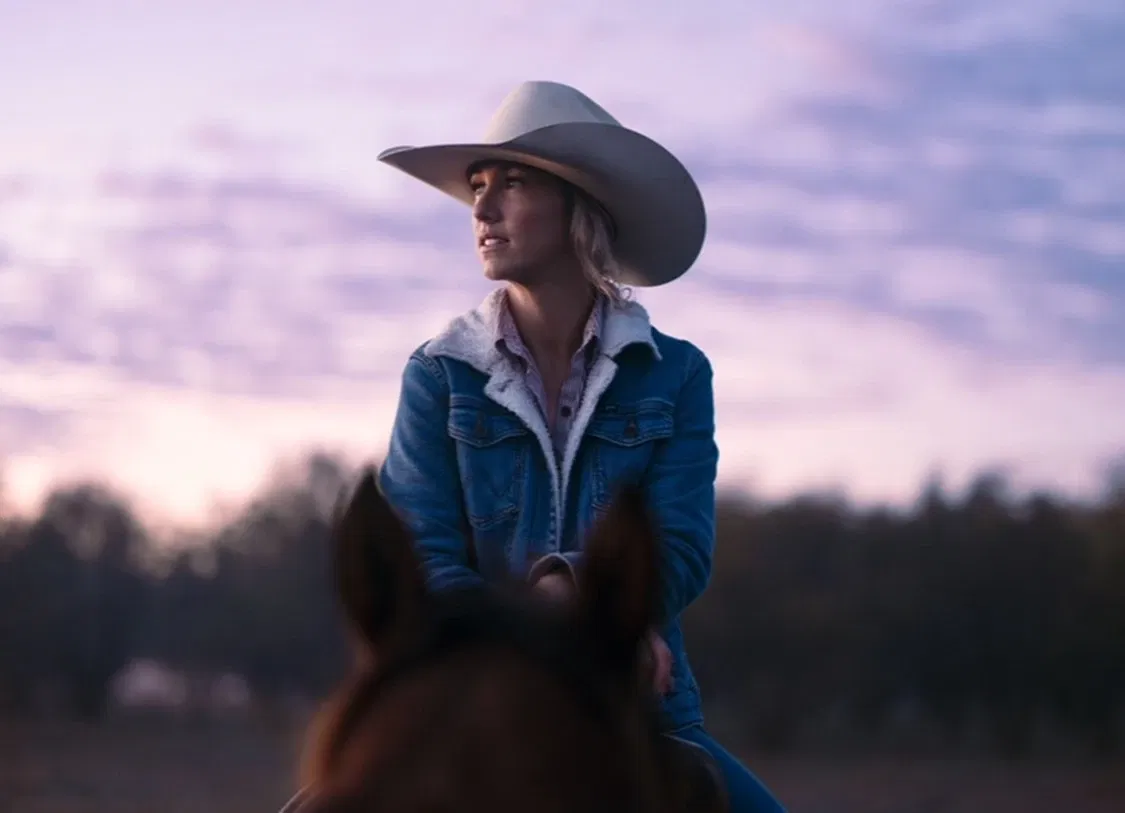


Jorden Halvorsen was 24 years old when trampled by a bull – temporarily sending her to The Great Beyond.
 Courtesy Aaron Anderson
Before briefly exiting life, she’d been paying serious dues as a bull rider. It was a grind she enthusiastically accepted at 17 after sliding atop a beast named Snowball in a bucket-list caper to see if she were up to the challenge.
She remembers nodding her head. Then an exhilarating blur: Flipped backwards. On the ground. Sickest ride of my life. Oh, wow, I gotta do this again.
Halvorsen, now 29, was born on an Air Force base in Florida – her mother served in the Air Force and her father in the Marines. They divorced when she was in seventh grade. She describes herself as a wild kid (“feral,” she remembers) always outdoors, growing up in the hunter-jumper rings of North Carolina. She won her share of ribbons and also bucked off aggressive horses. But this – the power, the urgency, the consequential stakes – was different. The trajectory of her life was changed by a few violent seconds she barely remembered.
Once she tasted the challenge of bull riding, mastering the dangerous task of dancing in time with a powerful and unpredictable bovine turned into an unshakable craving. She’dmake cramped-leg drives from North Carolina to Texas, hauling ass Thursday nights as soon as her job as a stable hand let out, tearing southwest on the interstate for weekend competitions that might pay for gas and tolls if you stayed on, a stop at Love or Pilot on the way to grab some sleep with Star, her big golden retriever companion inevitably on top of her in the musty confines of a Toyota Corolla replacing the Ford Focus which lost its front end after smoking a coyote who’d been in the wrong place at the wrong time.

Who’d ever trade away this – a chance to do what you love most?
Now in the fuzzy haze of semi consciousness after she’d been smoked, wrong place wrong time, this is how it ends? In a Tennessee hospital with a sliced-up liver? After riding her first bull that night putting her into the event lead?
Covering two-time PBR World Champion J.B. Mauney for the Washington Post, Sally Jenkins documented the force exerted by a bucking bull. “The hind hoofs of a large bull generate a force of 106.3 kilonewtons. An Olympic boxer delivering a straight punch, just 3.4,” Jenkins reported.
After the bull – she doesn’t remember his name, only his “SS” ear tag – stepped on Halvorsen with the force 30 times that of an Olympic boxer, most of her liver had been destroyed.
No way to treat a lady.
They may hold the exalted position of veritable kings in a hats-off “yes ma’am, no ma’am” culture, but bucking bulls, once they go to work, harbor no politeness for anyone. They’re trained for a singular job that does not include recognizing gender. There is no decorum-driven chivalry in a bull’s in-bred mission simply because the human athletes craving the high filling their veins during games of ring and run at death’s door (or whatever implores every new generation to torch-bear the original “holy shit” sport) happens to be female.
On the operating room table, Jorden’s heart stopped beating.
In the distance she saw a Godlike holy figure. “I’m not ready! I’m not ready!” she told him. The doctors got her heart going. She flatlined again. Working frantically, they revived her a second time.
Three days later, Jorden Halvorsen woke up.

The night Jorden was stomped in March 2020, the most severe COVID-19 restrictions were going into effect. Adding to the surrealness of waking up from a coma, the world had shut down. Her dad was allowed in the ICU. But when moved to a room, she quarantined alone for 10 days.
God’s ultimate reprieve after clinically dying two times was a sign pointing Jorden in one direction – right back to the bucking chutes.
She had to get on again because being a bull rider is who she is. Even if it means continuing to consent to the onslaught of lethal hooves and horns that should have already killed her.
“I don’t think God makes mistakes,” Halvorsen said. “I don’t think He’d give me this fire, and heart-pounding passion to want to ride bulls again, if I wasn’t meant to do something positive and uplifting with it. He has given me this avenue to do something positive in the world – to grow the sport of women’s bull riding and testifying with my story to give power to those people struggling. He’s given me this story and the testimony to be a positive light in this world.”
That was in 2020, not long after Chase Outlaw had his face exploded in Cheyenne on a bull named War Cloud only to come back three months later, ride lights out, and nearly win the PBR world title.
Observing Outlaw’s resilience after breaking 30 bones in his face, following seemingly pain-immune riders like J.B. Mauney, or 2024 World Champion Cassio Dias who fractured bones in his back at the beginning of PBR’s championship tournament only to be released from the hospital and ride the following weekend to win his title, and hearing impossible-to-relate to stories of fearless determination like Halvorsen’s, one may wonder if a leading medical research institution should run advanced DNA, blood and brain mapping tests on bull riders, because there has to be something discernably amiss in these human being’s genes or hormones or the synapse highway crisscrossing the pinkish-grey goo of their brains to explain freakish behavior mixing recklessness immune to reasonable caution and courage without brakes.
I crack my shin on the coffee table and avoid the living room for weeks. Bull riders would be comfortable in a dentist’s office in the early 1800’s.
Healing up, Jorden responded to everyone who asked that she’d be getting back on. One bull or 100, she didn’t know.
But she wasn’t quitting. That much wasn’t up for debate. And death’s not that scary when you’ve already been there. Flatlining only strengthened her faith in God, her desire to ride bulls.
 Jorden Halvorsen has yet to lose a “my scar is
better than your scar” contest.
Jorden Halvorsen has yet to lose a “my scar is
better than your scar” contest. Jorden did what bull riders do. She got back on.
She attended a PBR Teams combine in Colorado in 2022 and covered her bull. She wasn’t drafted by one of the eight professional teams, but making the whistle on Told Ya Once with coaches such as former World Champions Michael Gaffney, Justin McBride and Jerome Davis at the fence analyzing every jump was a sizable confidence boost after nearly losing her life to bull riding. She competed in the WBRO (Women’s Bull Riding Association) circuit. She joined the Netflix reality series “How to Be a Cowboy” starring cowboy Dale Brisby, landing a full-time job with Brisby and becoming a leading face and advocate for women’s bull riding.
Limited opportunities in WBRO and WPBR (Women’s Professional Bull Riders, which she’d competed on in 2018) were drying up. The WPRA (Women’s Professional Rodeo Association) was no longer running rough stock events.
Halvorsen felt a calling to give women riders a league of their own. She wanted more opportunities for them, but beyond that, respect in the western sports industry. In 2023, she conceived and launched Elite Lady Bull Riders, recruiting nearly two dozen riders.
By the next year, ELBR was holding more than 30 points events in a half dozen states, tagging onto existing rodeos since there aren’t enough qualified women riding bulls to support standalone events.
Women’s sports have arguably been the hottest new development in organized athletics over the past five years. Global revenue for women’s sports is projected to exceed $2.35 billion 2025, a 300% rise since 2021, according to Deloitte. Unfortunately, those dollars have yet to support Halvorsen and the handful of women passionate about bull riding.

But that could change if a new documentary, “Not Her First Rodeo,” becomes a hit.
The six-part docuseries from ABC News Studio, which drops on Hulu and Hulu on Disney+ on June 6, follows Halvorsen and four other riders on tour risking life and limb for scant pay and a championship buckle unknown to most sports fans.
One of the riders comes from a Brazilian family familiar to many rodeo fans. Renata Nunes, 19, the daughter of 2010 PBR World Champion Renato Nunes, displays an impish sense of humor while bearing the pressure of living up to the expectations of a father who encourages her to shed blood for her bull riding dream.
The show’s other athletes are Alexia Huffman, 26, a US Army veteran earnestly committed to improving; Catalina Langlitz, 22, once nearly killed by a bull and questioning her commitment to the sport; and Athena Rivera, 19, an affable Mexican and champion barrel racer before being bitten by the bull riding bug.
“Not Her First Rodeo” is the brainchild of Sabrina Garcia, a New York-based producer for ABC News Studios, who in observing rodeo’s emergence in the cultural zeitgeist was fascinated by its “hidden worlds outside of the typical white male cowboy.”
When Garcia came across an article about Langlitz – who was introduced to rodeo at Cowboy Church when she was three years old, learned to ride, and won 2021 WBRO title – she was stunned to discover the existence of female bull riders.
Langlitz connected Garcia to Halvorsen, who had just created the new women’s tour. With the lady riders on board and production rolling, she appreciated Halvorsen’s no-nonsense drive and deep dedication to her craft.
One night after filming a rodeo, Garcia found Jorden alone in the back of her car, scribbling in a thick notebook.
“She was writing the names of the bulls she had just ridden, how many seconds she had stayed on, and an observation about her performance – hundreds of pages detailing hundreds of bull rides,” Garcia said. “Jorden has the discipline of an Olympian when it comes to bull riding.”
The four-time world champion is also the best rider of the bunch.
“She’s won a few buckles at co-ed bull ridings,” said Brisby, CEO of Rodeo Time, where Halvorsen works in the media department. “She’s very passionate about bull riding as a competitor, rather than someone just trying to make a point, which is sometimes what you get with bull riders. She has a willingness to try during the bull ride. She’s not looking for an exit or to jump off difficult bulls.”
 Courtesy Aaron Anderson
For her tour to gain traction, others need to step up. Halvorsen’s standards for her riders are high; in the Hulu series she telegraphs disappointment with perceived complacency even in a sport that is emotionally, physically and financially brutal.
The struggle is real, and the ladies get banged up, which provides fuel for those maintaining only men should be able to sacrifice their bodies for an athletic dream.
As rodeo announcer Blue Jeanes put it in one episode, “If my daughter came to me and said, ‘Dad, I want to ride bulls,’ I’d say ‘No.’ It’s one thing to take a chance on dying to be a millionaire. It’s another thing to take a chance on dying to win 150 bucks.”
Claire Weinraub, an executive producer at ABC News Studio, wanted “to capture the grit, passion, and resilience of women who refuse to be underestimated.” She calls the series an authentic adrenaline-fueled ride to a place rarely seen and impossible to forget.
Halvorsen competed in 21 rodeos in 2024, winning or placing in 15 of them, earning enough points to win the 2024 championship. However, after another serious injury at a bull riding in Brownwood, Texas, she was unable to compete at ELBR Finals in Mesquite, Texas last November.
On a double entry, she covered her first bull. On the second, she lost his center and was hung up in the bull rope. When she hit the ground, the bull spun around and crashed down on her lower right leg, smashing her fibula and splintering off her tibia.

Doctors placed a rod into the main bone, the tibia. Jorden didn't flatline this time. But the broken bones, torn up calf, and protruding screws at the bottom of the rod in her leg hurt a lot more than her chopped liver. The first night, Jorden sweated so profusely though the pain, the nurses assumed she had wet the bed.
“Jorden is experiencing the pounding you get as a rough stock competitor,” Brisby said. “It really starts to settle in at 30. A true rodeo cowboy says, ‘I’m not done yet,’ and Jorden is just like that.”
But her body was sending signals, and the leg wasn’t healing properly. In early April, during her fifteenth surgery as a bull rider, doctors inserted a new rod.
The leg is improving…slowly. Following a full rehab, Jorden’s next bull will be part of a competition she wages against herself, the words “I can do better” repeating in her head.
In a sport where competitors pay to enter, and some leave with nothing but bumps, bruises and the sting of defeat, Halvorsen is determined to not be what she calls a “money donor.” She’ll push her recovery to the limit to make sure she winds up at the secretary’s table, taking home a check.
“When I enter a rodeo, I want anyone seeing my name on the list to say, ‘Shit, this one’s going to ride her bulls, she’s gonna take our money’,” she said.
When she returns to competition it will be more than a dozen years of dealing with her bull riding addiction. Her return date is unknown. But there have never been timelines. Or fears. Or regrets.
Only the certainty of the next bull.
The biggest fear right now is what happens when she can no longer compete.
“My identity without bull riding scares me,” Halvorsen said.
She will get on again. Some time. Some place. It’s what bull riders do.
For Jorden Halvorsen, pushing herself and the women around her in a brutal unforgiving sport, the question is: how many bulls will be left to ride?